Competitor price monitoring for brands that sell through retail
Competitor price monitoring for retail-distributed brands tracks how your own SKUs and competing products are priced across both national e-commerce URLs and individual brick-and-mortar store locations. Online price tools such as Price2Spy and Prisync excel at tracking marketplace URLs and D2C sites, but brands selling through Home Depot, Lowe's, Tractor Supply, and farm dealers also need store-pinned checks to catch zone pricing, local promos, and clearance tags.
Key facts
- Prisync publishes URL-based price monitoring plans from $99 per month for 100 products to $399 per month for 5,000 products with MAP monitoring (checked November 2026). Source: prisync.com
- Price2Spy offers Starter, Basic (with MAP monitoring and instant alerts), and custom-quoted Premium plans with an optional screenshot capture module (checked November 2026). Source: price2spy.com
- FrigginYeah publishes MAP monitoring from $129+ per month (Amazon Lite) and $659 per month (Standard, 4 sites, 200 SKUs per site), plus custom store-level Home Depot and Lowe's data files (checked November 2026). Source: frigginyeah.com
- Federal antitrust law under Sherman Act Section 1 and parallel state statutes, such as California's Cartwright Act, prohibits specific anticompetitive conduct. Source: law.cornell.edu
On this page
What is competitor price monitoring for retail-distributed brands?
Competitor price monitoring for brands that sell through retail tracks two moving targets simultaneously: how your own SKUs are priced across retail stores and marketplaces, and how competing brands price equivalent items shelf by shelf. For the broader view of stock availability alongside pricing, read our brand guide to store-level shelf intelligence.
Most articles about competitor price monitoring assume you are a direct-to-consumer e-commerce store running dynamic repricing rules against three online rivals. Manufacturers selling fasteners, electrical gear, tools, lawn equipment, or farm supplies through brick-and-mortar retail have a harder problem. You rarely control the final shelf price at Home Depot, Lowe’s, Tractor Supply, or a regional hardware co-op—yet your national account managers still hear about regional undercuts, margin pressure, and promotional shifts directly from buyers and field reps.
As Profitero+’s digital shelf documentation notes, brands track competitor and retailer pricing both to detect Minimum Advertised Price (MAP) violations and to prevent destructive race-to-the-bottom price matching across channels. For physical retail brands, that tracking only works when it captures local store tags, not just one national web page.
Why do online price monitoring tools miss store-level shelf prices?
Online price monitoring software is built around product URLs and e-commerce marketplaces, which creates a structural blind spot wherever big-box retailers price by local market.
According to public pricing pages checked in November 2026, mainstream SaaS price monitors organize plans by URL count and check frequency:
| Tool (checked Nov 2026) | Published pricing tiers | Core focus | Store-level big-box limitation |
|---|---|---|---|
| Prisync | URL-based $99/mo (100 products), $199/mo (1,000), $399/mo (5,000, adds MAP); Channel-based $199–$599/mo; API +20% | Online store dynamic pricing, marketplace tracking, online MAP | Built around product URLs and sales channels rather than named physical store lists |
| Price2Spy | Starter, Basic (adds MAP monitoring and alerts), Premium (custom quote, up to 8 checks/day, API) | E-commerce price tracking, product matching, MAP screenshot capture | Tracks online storefronts and marketplaces rather than store-pinned shelf variance |
| FrigginYeah | MAP Lite $129+/mo (Amazon), Standard $659/mo (4 sites, 200 SKUs each), Enterprise custom | Online MAP plus custom Retail Shelf Intelligence for HD/Lowe’s | Separate custom data service for big-box store pulls; no field team to verify shelves |
For a deeper look at tier structures and features, see our breakdown of price monitoring software pricing, our MAP monitoring software guide, and our comparison of Price2Spy versus store-level data.
When a national URL check pulls a big-box retailer without pinning individual store numbers, it misses three daily retail realities:
- Regional zone pricing: Home improvement and farm chains vary shelf prices across metropolitan markets, freight zones, and local competitive clusters. Read more in why shelf prices differ by store at Home Depot and Lowe’s.
- Local promotions and bulk breaks: Pro-desk multi-unit discounts, regional endcap circulars, and seasonal markdowns frequently appear in specific districts weeks before—or completely independently of—national web listings.
- Clearance vs. active price drops: Without pairing price with local pickup stock, a $20 discount looks like an aggressive price war when it is actually a single store clearing out two damaged units.
How should a brand track competitor prices region by region?
Effective brand-side price monitoring mirrors how your sales territories are managed rather than pulling an entire national catalog blindly. Follow a structured four-part setup:
- Select a representative regional store list: Choose 10 to 30 anchor stores spanning your top sales districts, high-competition metros, and lower-margin rural markets. Include stores where field reps already run comp shops so data and store visits reinforce each other.
- Build a matched SKU crosswalk: Map your core items directly against equivalent competitor SKUs by pack size, gauge, horsepower, or kit configuration. Comparing a bare tool price against a kit with two batteries corrupts every chart.
- Capture price, promo flag, and stock status together: Record regular shelf price, active promo or bulk-break pricing, and local pickup availability in the same row so category managers know whether a competitor is actively promoting or out of stock on a markdown.
- Track week-over-week price variance: Highlight only the stores and SKUs that moved since last Tuesday. An account manager preparing for a buyer call needs a clean one-page variance summary, not 20,000 identical rows.
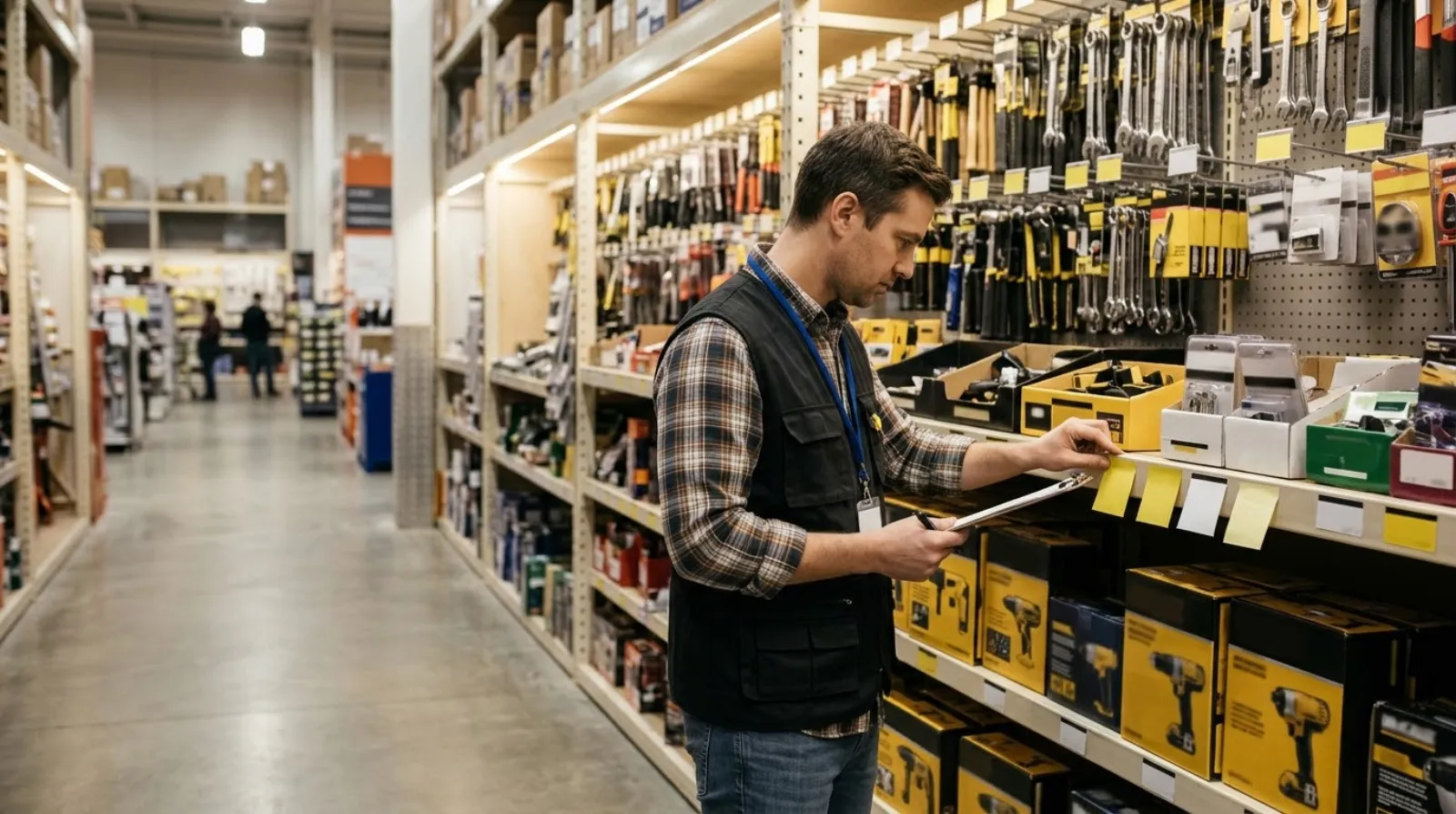
If your field team still audits competitors in person with clipboards, our guide on how to run a store comp shop at big-box and our free store spot-check sheet generator keep manual aisle checks structured.
Worked example: catching regional price variance and a promo undercut
Pairing shelf price with local pickup availability prevents a sales team from misreading a local clearance tag as a national price war. Say a hypothetical hand-tool brand sells its flagship SKU at a $49.99 baseline across 30 stores in four sales districts alongside a competing brand’s equivalent item:
| Sales district (sample stores) | Your SKU shelf price | Competitor SKU shelf price | Competitor pickup stock | What the Price Variance tab tells your account manager |
|---|---|---|---|---|
| Midwest (8 stores) | $49.99 | $49.99 | In stock at all 8 stores | Price parity; no action needed |
| Southeast (8 stores) | $49.99 | $44.99 (promo flag) | In stock at 7 of 8 stores | Active regional promotion; track sell-through impact before matching |
| Southwest (7 stores) | $47.50 (zone price) | $49.99 | In stock at all 7 stores | Retailer zone pricing lowered your local shelf price by $2.49 |
| Pacific Northwest (7 stores) | $49.99 | $34.99 at 1 store; $49.99 at 6 | 1 unit left at discounted store | Single-store clearance closeout rather than a district-wide price cut |
Without store-pinned stock and price in the same row, an email alert about a “$34.99 competitor price” triggers panic on a Monday call when only one store is clearing a final box. Checking regional pricing together with store-level inventory vs. “available online” keeps promotional budgets focused on real district pressure.
Common mistakes brands make in competitor price monitoring
Manufacturers moving from e-commerce URL monitors to brick-and-mortar retail pricing often run into four preventable mistakes:
- Comparing mismatched SKU configurations: Matching a single-pack SKU against a competitor’s multi-pack or bare tool against a battery kit produces false price-gap alerts.
- Reacting to closeout tags with one unit remaining: Treating a local clearance markdown as a permanent price cut wastes trade promotional funds when the competing peg is nearly empty.
- Relying on one national web URL: National product pages miss metro freight zones, Pro-desk multi-unit breaks, and regional endcap promotions across big-box footprints.
- Mixing market intelligence with dealer price coordination: Collecting public shelf prices is standard competitive benchmarking, whereas pressuring retailers or agreeing on resale price floors with competitors creates antitrust risk.
What legal guardrails apply to brand price monitoring and MAP?
Watching publicly posted retail shelf prices to understand market positioning is routine competitive intelligence. Taking action on what you find—especially around reseller pricing—carries real antitrust boundaries.
As Cornell Law School’s Legal Information Institute antitrust overview summarizes, Sherman Act Section 1 prohibits anticompetitive price agreements, and state antitrust laws—such as California’s Cartwright Act—enforce strict rules alongside federal law. Violations carry heavy civil and criminal exposure.
Keep three practical guardrails in front of your sales and trade marketing teams:
- Never coordinate prices with competing manufacturers: Sharing price plans or agreeing on shelf price floors with competitors violates horizontal price-fixing prohibitions outright.
- Separate monitoring from coercion: Under unilateral pricing and Minimum Advertised Price frameworks, manufacturers must avoid negotiating or coercing resale price agreements with dealers. Consult antitrust counsel before issuing warnings or cutting off accounts.
- Put your policy in writing first: Use clear, counsel-reviewed policy language defining what counts as advertised pricing versus in-store shelf tags. Review how to write a MAP policy and draft a starting outline with our MAP policy generator for your attorney to review.
This overview is informational and not legal advice; consult antitrust counsel before drafting or enforcing any pricing policy.
How to set up store-level price monitoring without enterprise software overhead
Mid-market brands selling $10M to $500M through big-box and farm retail rarely need a multi-year enterprise analytics contract just to track regional shelf prices and stockouts across their key accounts.
Front Row’s weekly store-level stock and price report monitors your SKU list and matched competitor SKUs across your named stores every week for a fixed monthly service fee—$750 per month for Tier S (up to 20 stores, 300 SKUs), $1,500 per month for Tier M (up to 30 stores, 800 SKUs), or from $2,500 per month for Tier L (up to 100 stores, 2,000 SKUs). Every workbook includes a dedicated Price Variance tab alongside stock status and week-over-week changes.
If you want to validate regional price differences on a single retailer before committing monthly, start with a one-time $750 Shelf Snapshot (up to 20 stores and 300 SKUs, credited toward setup within 30 days) or preview the synthetic workbook layout on our sample report page. Every data pull adheres strictly to publicly displayed store pages paced like a shopper, as documented on our data sourcing statement.
Who inside a brand uses weekly store-level price variance data?
Once a brand receives a structured weekly workbook, four teams use the same Store x SKU grid and Price Variance tab without building separate spreadsheets:
- National Account Managers: Bring store-by-store price variance and promo parity data to 60-to-90-day buyer line reviews using our retailer line review checklist.
- Trade Marketing: Verify that funded regional promotions and endcap rollouts show the intended shelf price across target districts during active promo windows.
- Category Analysts: Slice flat Store x SKU rows by region, chain, and SKU group inside Excel pivots or Power BI without spending two days pulling screenshots manually.
- Field Sales and Merchandisers: Focus store visits on locations flagged for missing promo tags or persistent shelf-price mismatches, or pair reporting with Front Row’s field team under the Shelf-to-Shelf program.
Clear scope limits also matter: Front Row’s weekly reports track physical store shelf pricing across your chosen store lists and competitor SKUs, and do not include automated online MAP violation notices, marketplace takedowns, or automated repricing bots. Review full tier rules on our pricing page.
Frequently asked questions
Why do online competitor price monitoring tools miss store-level shelf prices?
Most e-commerce price monitors fetch a single national product URL or marketplace listing. When a big-box chain varies shelf prices by market, ZIP code, or store tier, a national URL check records only one default price. Without pinning individual store numbers, regional price drops, local clearance markdowns, and district promotional tags go unnoticed.
How much does standard online competitor price monitoring software cost?
According to public pricing pages checked in November 2026, Prisync URL-based plans run $99 per month for 100 products, $199 for 1,000 products, and $399 for 5,000 products (channel-based plans run $199 to $599 per month). FrigginYeah publishes MAP tiers at $129+ per month for Amazon only and $659 per month for four websites, while Price2Spy quotes tiers by volume.
Why should brands track competitor stock status alongside competitor price?
A sudden 30 percent price drop on a competitor's SKU means something very different if that store shows only one clearance unit remaining versus full shelf replenishment. Pairing local shelf price with pickup availability prevents national account managers from overreacting to closeout markdowns or missing aggressive regional promotions.
Is it legal for a manufacturer to monitor competitor and retailer shelf prices?
Monitoring publicly displayed retail prices for competitive benchmarking is standard business practice. However, how a brand acts on pricing data—especially when enforcing Minimum Advertised Price (MAP) policies or communicating with retailers—is governed by federal and state antitrust laws, so pricing policies should always be drafted and reviewed with legal counsel.
How can a hardlines or farm brand start tracking store-level prices without an enterprise suite?
Start by defining 10 to 30 representative stores across your key sales districts and matching your core SKUs against direct competitors. You can collect manual aisle checks using our free Spot-Check Sheet Generator, order a one-time $750 Shelf Snapshot across 20 stores, or subscribe to weekly store-level stock and price reports starting at $750 per month.
Sources
- Prisync Pricing & Plans | Prisync (checked )
- Price Plan Comparison | Price2Spy (checked )
- MAP Monitoring Pricing | FrigginYeah (checked )
- Retail Shelf Intelligence & Comp Shop Data | FrigginYeah (checked )
- Antitrust | Legal Information Institute, Cornell Law School (checked )
- Digital Shelf Analytics & eCommerce Insights | Profitero+ (checked )