Price monitoring tools versus store-level data
Online price monitoring tools like Price2Spy track competitor product URLs across websites and marketplaces to flag price changes, run dynamic repricing, and enforce MAP policies online. Store-level shelf data tracks physical store pickup availability, stock counts where shown, and regional shelf prices by individual store number—visibility that URL-based e-commerce monitors are not built to provide.
Key facts
- Price2Spy offers three pricing tiers—Starter (up to 10 competitors), Basic (MAP monitoring and marketplace monitoring), and Premium (API access, up to 8 checks per day, and 3 user seats). Source: price2spy.com
- Price2Spy provides a 14-day free trial and monitors competitor websites across any language and currency. Source: price2spy.com
- Price2Spy restricts MAP monitoring and marketplace tracking (such as Amazon, eBay, and Walmart) to its Basic tier and above, with optional violation screenshot capture available as an add-on. Source: price2spy.com
- Price2Spy's MAP monitoring tracks online resellers and marketplaces, exporting violation reports and capturing price-change screenshots for reseller enforcement. Source: price2spy.com
On this page
What online price monitoring tools actually see
Online competitor price monitoring tools like Price2Spy track product URLs on e-commerce websites and marketplaces to show who lowered a web price or broke an advertised price floor.
For an online retailer or an omnichannel brand managing dozens of e-commerce dealers, that URL-based model works well. On its price monitoring page, Price2Spy highlights coverage across any website, language, or currency, with a 14-day free trial and matching options (manual, hybrid, or Automatch) to pair your catalog against competitor URLs.
Price2Spy structures its plans around URL capacity and workflow features on its pricing comparison page (checked November 2026):
- Starter: Daily price checks for up to 10 competitors, pricing dashboard, bulk CSV import, and daily alerts—without marketplace monitoring, MAP monitoring, or custom reports.
- Basic: Unlimited competitors, marketplace monitoring (such as Amazon, eBay, and Walmart), MAP monitoring, instant price alerts, historical charts, e-commerce integrations, and one automated custom report.
- Premium: API access, up to eight price checks per day, user management with three seats, additional product attributes, and five custom automated reports, priced upon request.
For brands running online MAP enforcement, Price2Spy also offers screenshot capture and automated repricing as separate add-on modules. You can see how tiered URL pricing fits the broader market in our breakdown of price monitoring software pricing, or review buyer criteria in our MAP monitoring software guide.
How matching and add-on modules work
On Price2Spy’s pricing comparison page and MAP monitoring page, several specialized capabilities sit outside the base Starter package as higher-tier features or separate modules:
- Product matching options: Teams pair their catalog to competitor URLs using Manual product matching, Hybrid product matching, or Automatch (automated matching for industries with standardized product identifiers).
- Separate-cost modules: Repricing, Capturing screenshots (for MAP violation proof), Google Analytics 4 integration, Account control, Product data extraction beyond base price, and Custom development are billed separately from the base tier.
- Usage-based additions: Bot-aware sites may require paid Stealth IP traffic megabytes, alongside charges for additional user seats or extra automated reports.
What store-level shelf data captures that URL trackers miss
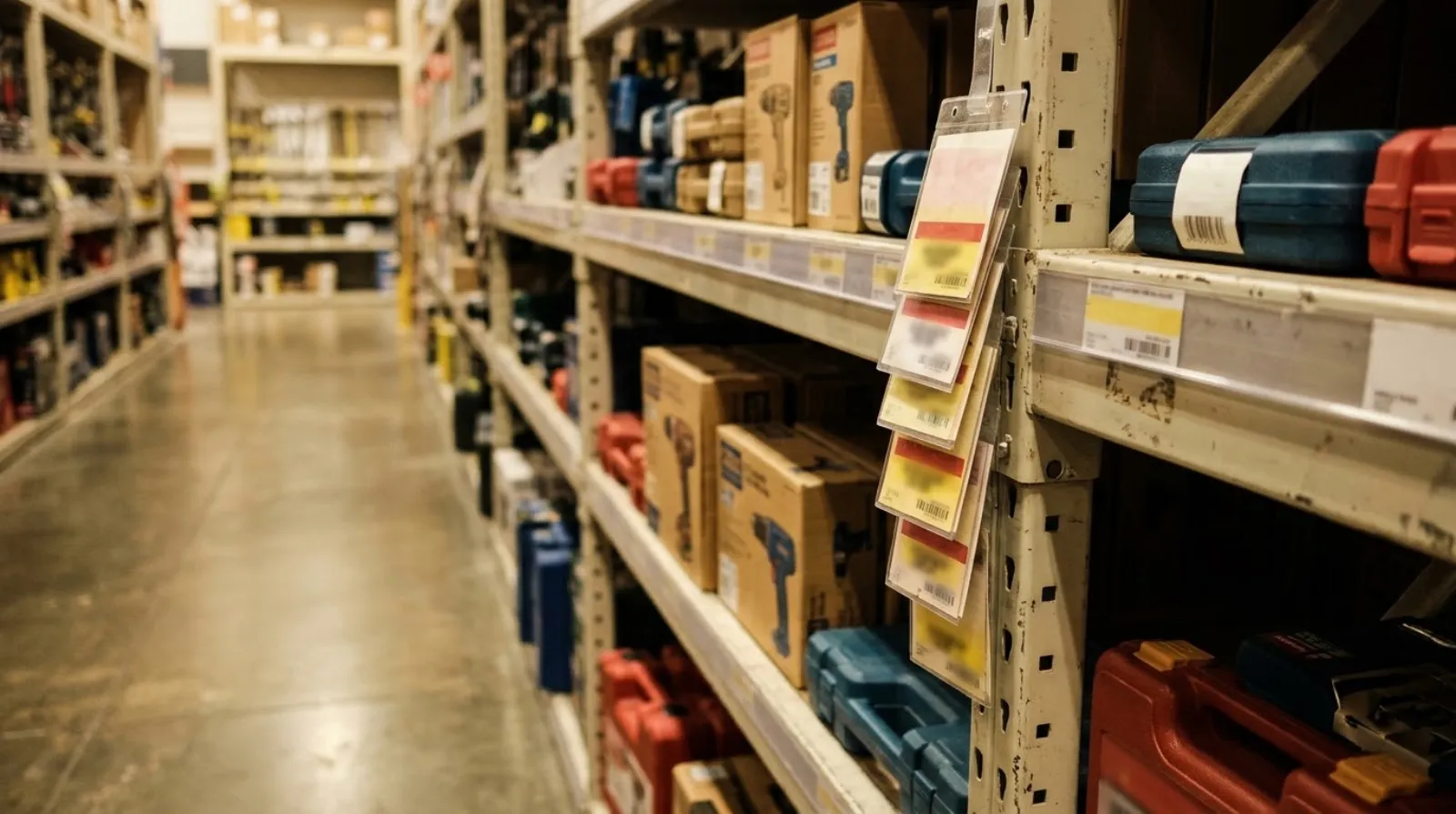
Store-level shelf reporting pins your SKU list to specific physical store numbers so you see local pickup stock and regional shelf prices rather than a single national web page.
When a hardlines, electrical, or outdoor brand sells through brick-and-mortar chains like Home Depot, Lowe’s, Tractor Supply, or regional farm retailers, one product URL does not represent one price or one inventory status. Retailers adjust shelf prices by geographic price zone, run local clearance or promo flags, and hold different quantities across individual stores.
An unpinned URL check tells you what the retailer’s national e-commerce catalog lists—often showing “available to ship” from a distribution center even when many of your priority stores have zero units on the shelf. A weekly store-level stock and price report checks each SKU against each store on your list and delivers five structured tabs:
- Store x SKU Grid: Stock status, quantity where the retailer displays it, and local shelf price for every store and item pair.
- Change Summary: Items where stock dropped, went out of stock, came back in stock, or changed shelf price since last week.
- Exceptions List: Priority stores ranked by out-of-stock count so account managers know where to look first.
- Price Variance Tab: Store-by-store differences between your target shelf price and actual regional pricing.
- Run Log & Data-Source Statement: Exact run timestamps and any store-level access flags logged during the pull.
For a deeper look at why national e-commerce status diverges from physical aisles, read our guide on digital shelf analytics vs. store-level data, our explanation of why shelf prices differ by store, and our overview in the brand guide to store-level shelf intelligence.
Worked hypothetical example: online MAP leak vs. regional shelf variance
Say a mid-market tool brand sells a $49.99 accessory both online through 15 e-commerce resellers and physically through 30 priority brick-and-mortar stores. Two completely different pricing issues can happen in the same week:
- Online MAP issue: An online monitor like Price2Spy checks the 15 dealer URLs daily and catches two marketplace sellers listing the item at $41.99, generating violation alerts and optional screenshots for channel enforcement.
- Physical store variance: Simultaneously, a regional retail district drops the in-store shelf price to $42.00 across six stores in the Southeast while eight Midwest stores go out of stock for local pickup. Because an unpinned national product URL still displays $49.99 and “available to ship,” the online monitor reports everything as normal—while a Core A Tier M report ($1,500 per month) isolates those exact six price-variance stores and eight stockout stores in one Excel workbook.
In that scenario, the e-commerce channel manager acts on the Price2Spy MAP alert, while the national account manager uses the store-level workbook—or dispatches field reps through our Shelf-to-Shelf program—to investigate regional pricing and shelf replenishment.
Pricing models and entry options compared
Online price monitors generally scale by monitored URLs and check frequency, while Retail Channel Ops prices by physical store count, SKU count, and retailer count.
| Pricing dimension | Price2Spy (checked Nov 2026) | Retail Channel Ops |
|---|---|---|
| Billing basis | Tier (Starter/Basic/Premium) plus URL volume and modules | Fixed monthly tier by stores, SKUs, and retailers |
| Published dollar tiers | Quote-led on pricing page | $750/mo (Tier S: 20 stores, 300 SKUs); $1,500/mo (Tier M: 30 stores, 800 SKUs); from $2,500/mo (Tier L) |
| Setup fee | Included / custom dev optional | $750 (Tier S), $1,500 (Tier M), quoted (Tier L) |
| Entry test | 14-day free trial | $750 one-time Shelf Snapshot (20 stores, 300 SKUs, credited to Core A) |
| Extra cost drivers | Repricing, screenshots, Automatch, IP traffic add-ons, extra seats | Additional retailers, stores, SKUs, or optional field visits |
If you only need to watch 500 e-commerce URLs across online competitors, an online price monitor is built for that economics model. If you need 30 physical stores checked across 800 SKUs every week—with someone on our team maintaining the store list, QA’ing the workbook, and walking through exceptions once a month—Core A replaces hours of manual analyst work for a fixed monthly fee.
When Price2Spy is the right tool
Price2Spy is the better choice whenever your pricing problem lives on e-commerce websites, online marketplaces, and direct-to-consumer competitor stores.
Choose an online monitor like Price2Spy if your team needs:
- Automated e-commerce repricing: Online retailers that adjust store prices dynamically using margin and competitor rules need Price2Spy’s repricing module and e-commerce platform integrations.
- Online MAP enforcement across resellers: Brands tracking unauthorized third-party sellers across Amazon, eBay, Walmart.com, and dozens of online webshops benefit from Price2Spy’s MAP monitoring and violation screenshot evidence.
- High-frequency intraday web checks: Checking fast-moving online prices up to eight times a day on Premium is a pure e-commerce workflow that weekly store-level workbooks do not target.
- International multi-currency tracking: Price2Spy supports any website, currency, and language globally, whereas Retail Channel Ops focuses on US big-box, farm, and hardware chains.
When brands need both online monitoring and store-level data
Manufacturers selling simultaneously through online dealers and physical retail chains often run both tools side by side because they answer different questions.
Price2Spy watches whether online dealers are undercutting your MAP policy on web listings and marketplaces. Store-level shelf reporting watches whether your brick-and-mortar retail accounts actually have product on the floor in key districts—and whether a retailer adjusted your shelf price in one region without telling your national account manager.
| Brand channel goal | Best-fit tool category | Why it fits |
|---|---|---|
| Enforce online MAP on Amazon, eBay, or dealer sites | Online price monitor (Price2Spy Basic+) | Tracks seller URLs, marketplaces, and violation screenshots |
| Reprice a direct e-commerce storefront dynamically | Online price monitor + Repricing module | Pushes automated price rules to webstore platforms |
| Spot regional shelf-price zones across 10–100 stores | Store-level shelf report (Core A) | Pins each store number and flags price variance by district |
| Catch physical store out-of-stocks before POS drops | Store-level shelf report (Core A / Snapshot) | Records local pickup stock and week-over-week stock drops |
| Send a field rep to verify stock and reset signage | Store data + field team (Shelf-to-Shelf) | Connects weekly exception stores directly to photo-backed store visits |
Brands evaluating store-level price variance can also draft internal reseller terms with our free MAP policy generator (noting it is a starting template for legal counsel review, not legal advice), inspect our workbook tabs on the sample report page, or calculate lost store sales with our stockout revenue calculator.
How to test store-level data before changing tools
You do not need to replace an existing online price monitor to verify whether physical store gaps exist on your retail accounts.
Send us one retailer, up to 20 priority store numbers, and up to 300 SKUs for a one-time $750 Shelf Snapshot. Within five business days, our analyst delivers the store-by-SKU workbook, a one-page findings brief highlighting top out-of-stock stores and regional price variance, and a 30-minute walkthrough. If you move to a weekly Core A report within 30 days, the full $750 Snapshot fee credits toward setup. You provide only your store list, SKU list, baseline target prices, and recipient emails—and our data-sourcing statement explains how checks stay limited to publicly displayed store data at shopper-equivalent rates without logins, with a client-supplied portal-export option whenever a brand prefers it.
| Dimension | Price2Spy (Online Price Monitor) | Retail Channel Ops (Store-Level Data) |
|---|---|---|
| Primary unit tracked | Product URL on a website or marketplace (checked Nov 2026) | Store number x SKU on your target store list |
| Core problem solved | Online competitor price tracking, repricing, and online MAP | Physical-store out-of-stocks, pickup availability, and regional shelf price |
| Retailer footprint | Any e-commerce site, language, or currency; marketplaces on Basic+ (checked Nov 2026) | Tractor Supply, farm/hardware retail; big-box store lists (HD/Lowe's gated) |
| Check frequency | Daily on Starter/Basic; up to 8 checks/day on Premium (checked Nov 2026) | Weekly standard (Tier L supports mid-week spot checks) |
| Pricing structure | Starter/Basic/Premium tiers by URL volume; custom quote (checked Nov 2026) | Snapshot $750; Core A $750/mo (S), $1,500/mo (M), from $2,500/mo (L) |
| Trial or entry test | 14-day free trial on Starter/Basic (checked Nov 2026) | $750 one-time Shelf Snapshot (20 stores, 300 SKUs, credited to Core A) |
| MAP & dynamic repricing | Included on Basic+ (MAP) and Repricing module (checked Nov 2026) | Not included (reports regional shelf price variance only) |
| Field follow-up | None (software and data feeds only) | Optional Shelf-to-Shelf field visits with photo proof |
Frequently asked questions
Does Price2Spy track in-store shelf prices and pickup stock at specific store numbers?
Price2Spy is designed to monitor product URLs across e-commerce websites and online marketplaces in any language and currency. While optional modules handle product data extraction and IP routing, standard online price monitors focus on national web listings rather than pinning dozens of physical big-box store numbers to compare regional shelf prices and local pickup stock.
Why do online price tools miss shelf-price changes at Home Depot, Lowe's, or Tractor Supply?
National home-improvement and farm-retail chains set prices and stock by regional market or individual store. If a price monitoring tool requests a public product URL without pinning a specific store context, it sees a single default price or warehouse shipping status rather than what a shopper sees on the shelf in Store 4417.
How does Price2Spy structure its plans and features?
As checked on Price2Spy's pricing comparison page in November 2026, plans are divided into Starter, Basic, and Premium. Starter covers daily price monitoring for up to 10 competitors; Basic adds unlimited competitors, marketplace monitoring, MAP monitoring, and instant alerts; Premium adds API access, up to 8 daily checks, 3 user seats, and 5 custom reports.
Can Retail Channel Ops replace Price2Spy for online MAP enforcement or e-commerce repricing?
No. Retail Channel Ops does not offer online MAP violation workflows, authorized-seller tracking, Amazon marketplace monitoring, or automated e-commerce repricing rules. Brands that sell across dozens of online dealers and marketplaces still need an online price and MAP monitoring platform like Price2Spy.
When should a brand use both an online price monitor and store-level shelf data?
Manufacturers that sell both online through e-commerce resellers and physically through big-box or farm-retail stores often need both views. Price2Spy guards online MAP policies and marketplace pricing across dealer websites, while weekly store-level shelf reports tell national account managers which physical stores are out of stock or priced differently by district.
How can a brand test store-level shelf data without switching pricing tools?
A brand can run a one-time $750 Shelf Snapshot on a single retailer—covering up to 20 stores and 300 SKUs—without touching its existing online price monitoring setup. Within five business days, your team gets the store-by-SKU workbook, a one-page findings brief, and a 30-minute walkthrough.
Can Price2Spy track regional store prices using its Stealth IP module?
Price2Spy offers Stealth IP traffic as a usage-based addition on its pricing page to access websites that restrict automated traffic, alongside product data extraction and custom development services. However, its standard workflow monitors product URLs across e-commerce competitors and marketplaces rather than maintaining pinned physical store-number workbooks with local pickup stock and week-over-week store exception tabs.
What information do we need to provide to run a weekly store-level price check?
You send three inputs: your target store numbers and retailer names, your SKU or model-number list (plus optional competitor SKUs within your tier limit), and your baseline target shelf prices so the Price Variance tab flags regional discounts or increases automatically.
Sources
- Price Plan Comparison | Price2Spy (checked )
- Price Monitoring | Price2Spy (checked )
- MAP Monitoring Software | Price2Spy (checked )