AI store-visit reporting for merchandising and rep agencies
Managed AI store-visit reporting helps rep and merchandising agencies of 5 to 50 reps finish clean, photo-backed store reports without tedious mobile typing or Excel re-keying. Reps clone their last visit, dictate notes, attach shelf photos, and review every AI-drafted line before saving. Priced at $35 per rep per month ($350 floor) with a $1,500 setup, teams start with a 45-day $2,000 pilot.
On this page
Why 5-to-50-rep agencies outgrow generic forms and skip enterprise contracts
Small and mid-sized rep agencies fall in a gap between free form builders that force Excel cleanup and enterprise execution suites built for 500-rep national CPG teams. Managed AI store-visit reporting gives teams of 5 to 50 reps structured per-vendor reporting and role dashboards without annual lock-in.
Most agencies we speak with start on generic forms like Jotform or email checklists, then hit two walls: reps write inconsistent notes across vendor lines, and operations staff spend Friday afternoons copying rows into Excel for billing. Moving up to enterprise software solves structure, but often brings rigid terms—for example, Repsly states on its pricing page (checked November 2026) that all contracts require a 12-month minimum commitment with annual upfront payment and no free trial. See how the models compare in our Repsly alternative for small agencies and our guide to merchandising software for small agencies.
How rep reporting changes side by side
Most rep and merchandising agencies with 5 to 50 field reps lose productive selling hours to repetitive form entry, late Friday write-ups, and manual billing cleanup. Built inside Front Row’s own merchandising operation—where the core reporting app has been live in production since February 2026—our managed service replaces multi-step typing with fast, structured capture.
| Step | Typical agency workflow today | With AI store-visit reporting |
|---|---|---|
| Opening the visit | Rep scrolls blank fields and re-types vendor names and store notes | Clones the previous visit’s store header and recurring lines in one tap |
| Writing comments | Rep types paragraphs on a phone keyboard in the parking lot | Taps comment chips from prior visits or dictates plain voice notes |
| Sorting by vendor | Ops staff manually splits store notes across vendor lines for clients | Dictation parser maps observations into per-vendor lines automatically |
| Reviewing photos | Photos sit unnamed in a camera roll until uploaded days later | Attached shelf photos generate draft observations for rep review |
| Sending to clients | Manager edits typos and emails PDFs or copies rows into Excel | Role dashboards let clients and vendors view approved lines directly |
Calculate what current reporting hours cost your agency payroll using our visit report time-savings calculator, or read our full retail execution and store-visit reporting guide.
Five workflow tools built for working field reps
Every feature in the app grew out of real store visits across hardware, lawn and garden, and farm accounts:
- Clone last visit: Pulls forward the previous visit’s store structure, active vendors, and baseline notes so reps only edit what changed in the aisle.
- Comment suggestion chips: Offers one-tap field phrases based on historical comments for common conditions like low facings, missing tags, or top-stock pulls.
- Voice dictation parsed into fields: Converts spoken wrap-up notes into structured fields across multiple brands covered in the same stop.
- Photo analysis: Reads attached shelf and display photos to flag missing facings or signage notes for the rep to confirm.
- Playbook import: Lets managers paste text or upload TXT, CSV, DOCX, or PPTX vendor reset playbooks and turn them into reviewable visit checklist suggestions.
What a rep does inside a multi-vendor store visit
Field reps finish a multi-vendor report in roughly five steps without waiting until Friday night to re-type notes at home:
- Select the store and clone prior lines: Open the store record and pull forward the prior visit’s vendor structure and recurring baseline notes in one tap.
- Walk the aisles and tap comment chips: Mark shelf conditions, low facings, or missing tags quickly using historical comment chips instead of typing full sentences on a phone screen.
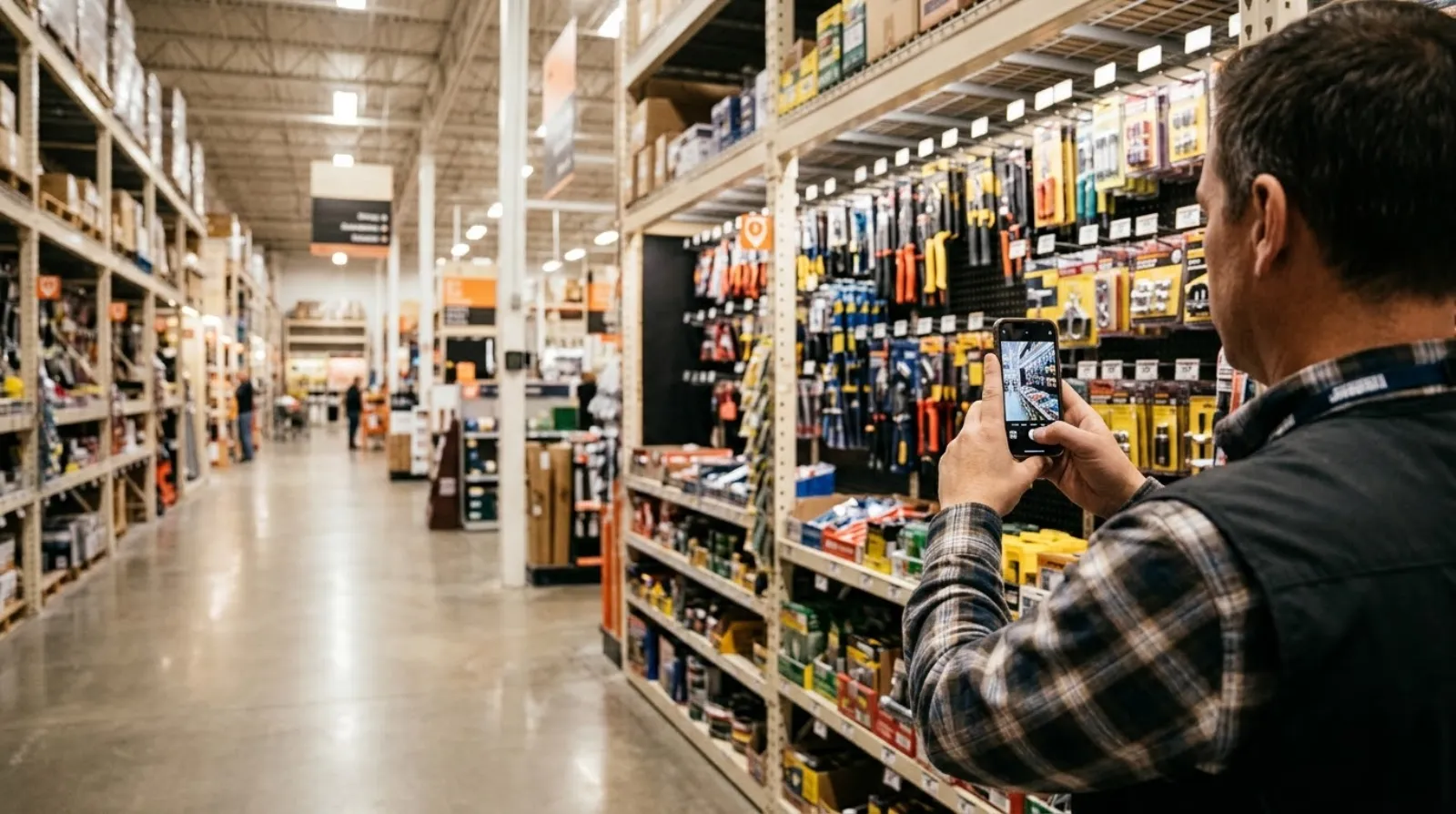
- Snap shelf and endcap photos: Attach clear photos per category or display; the app holds images locally inside dead-signal aisles until connectivity returns.
- Dictate a single spoken wrap-up: Speak plain store notes covering three to five brands at once so the parser drafts structured per-vendor lines automatically.
- Review the AI draft and submit: Check every drafted comment and photo note, edit or discard anything inaccurate, and tap submit so managers and clients see clean lines immediately.
Every AI result is reviewed before it is applied
Reps and agency owners rightly distrust black-box AI writing tools that invent observations or send sloppy prose to a major brand buyer. Every AI step in our workflow stays strictly advisory:
- Explicit review gate: Dictated summaries, photo observations, and playbook checklist suggestions appear as editable drafts that the rep approves, rewrites, or discards before submission.
- Per-task feature flags: Agencies can turn AI dictation, photo analysis, or playbook parsing on or off independently per client account.
- Metadata-only audit log: The system logs when AI drafting ran and whether a rep accepted or edited the draft, without burying your team in raw prompt clutter.
Dashboards scoped by role
One submitted visit feeds four separate views without exposing internal agency operations to outside brands:
- Admin dashboard: Manage rep rosters, custom fields, AI feature flags, and export settings.
- Manager dashboard: Spot incomplete visits, review flagged comments, and approve reports before client visibility.
- Client dashboard: Give account contacts clean access to store visits, timestamps, and shelf photos across their brand.
- Vendor dashboard: Scope individual suppliers strictly to their own SKU lines inside multi-vendor store visits.
Photos, autosave, and NetSuite billing exports
Concrete big-box stores often drop cell bars in the back aisle. Reports autosave continuously in the browser and hold photo attachments cleanly until signal returns, backed by built-in help-center tickets with two-business-day support.
For finance and ops teams, we offer two back-office add-ons: a NetSuite billing export (built on five working client transformers, including multi-vendor brand-time splitting, adapted to your chart of accounts—see our guide on turning visit reports into invoices) and monthly sales tracker automation for cumulative Excel reporting.
Data separation and channel-conflict safeguards
Because Front Row also runs a working retail sales and merchandising team, agency buyers rightly ask how their store lists and brand rosters stay private. Your agency’s store lists, vendor rosters, client dashboards, and shelf photos are strictly isolated from Front Row’s own field operations and are never shared with our rep business.
White-label branding is planned for a future release, and we confirm account-conflict terms with each agency prior to pilot kickoff. You can read more about how our rep and software operations evolved on our about page.
What this service does not do
We keep the product focused on visit reporting and vendor proof rather than bloating into tools small agencies do not use:
- No GPS routing or territory optimization: We do not build automated turn-by-turn route schedules.
- No mileage or payroll processing: Track expenses and pay runs in your existing accounting or HR software.
This service fits rep and merchandising agencies with 5 to 50 field reps covering multi-vendor hardware, electrical, lawn and garden, or farm accounts. If you manage fewer than 5 reps, our free store visit report builder or a simple spreadsheet is usually enough; if you run 100+ reps and need built-in territory routing or enterprise SSO, a larger enterprise platform fits better.
Pricing, data disclosure, and how to start
Managed AI store-visit reporting costs $35 per rep per month with a $350 monthly floor (up to 10 reps) and a $1,500 one-time setup fee covering template configuration, vendor mapping, and team training, billed monthly after setup. Every new agency starts with our 45-day visit reporting pilot ($2,000 fixed for up to 10 reps, credited toward your first three months).
| Agency size | Monthly Core B fee ($35/rep, $350 floor) | One-time setup | Pilot credit if converting from 45-day pilot |
|---|---|---|---|
| 5–10 reps | $350/mo (floor) | $1,500 | $2,000 pilot credited toward first 3 months |
| 20 reps | $700/mo | $1,500 | $2,000 pilot credited toward first 3 months |
| 35 reps | $1,225/mo | $1,500 | $2,000 pilot credited toward first 3 months |
Review full subprocessor and data rules on our AI disclosure page, try building a free PDF or Excel template in our store visit report builder, or book a walkthrough to see a live demo with redacted field reports.
Managed AI Store-Visit Reporting (Core B)
$35/rep/mo $350/month minimum floor (up to 10 reps); $1,500 one-time setup for template build and training
Start with a 45-day pilot (live in 10 business days)
What you get
- Clone-last-visit prefill and comment suggestion chips
- Voice dictation parsed into structured per-vendor lines
- Shelf photo analysis with human review before saving
- Playbook import (paste, TXT, CSV, DOCX, or PPTX)
- Admin, manager, client, and vendor role dashboards
- Autosave, photo storage, help-center tickets, 2-day support
How it works
- Import your templates and vendor playbooks Our team sets up your store fields, vendor list, and playbook prompts into one clean report flow.
- Reps dictate, snap photos, and review In the store, reps clone the prior visit, speak notes, attach photos, and approve the AI draft.
- Managers approve and clients view dashboards Role dashboards route brand-specific lines to clients while ops exports data for billing.
Frequently asked questions
Does the AI automatically send unedited comments to our vendor clients?
Never. Every AI output—whether parsed from voice dictation, drafted from shelf photos, or extracted from an uploaded playbook—appears as an editable draft inside the rep's screen. The rep or manager must review, edit, or discard each suggestion before it applies to the visit report, and per-task feature flags let you disable any AI feature per account.
What does managed AI store-visit reporting cost for a 10-to-25 rep agency?
Core B is priced at $35 per active rep per month with a $350 monthly floor (covering up to 10 reps), plus a $1,500 one-time setup fee for building your templates, vendor structure, and rep training. Most agencies start with our $2,000 45-day pilot for up to 10 reps, which credits directly toward your first three months of Core B.
How does this compare to Repsly or generic form apps like Jotform?
Generic form apps capture raw entries without vendor-level dashboards or prefill memory, forcing ops staff to rebuild reports in Excel. Enterprise platforms like Repsly require a 12-month minimum contract with annual upfront payment and no free trial (per Repsly's pricing page, checked November 2026). We offer a 45-day pilot, monthly billing after setup, and AI drafting tailored for small agencies.
What happens to our store photos and voice recordings?
Voice dictation, rep comments, and shelf photos are sent to third-party language and vision model providers only for the specific AI features enabled on your account. We maintain a metadata-only audit log of AI requests and publish our subprocessor and data-handling commitments on our AI disclosure page.
Does the software handle route scheduling, mileage tracking, or rep payroll?
No. We are clear about what our tool leaves out: it does not run GPS territory route optimization, mileage reimbursement, or rep payroll calculations. It focuses strictly on cutting visit-report entry time, standardizing vendor proof, and exporting clean report data for client visibility and NetSuite billing.
Front Row also runs a merchandising agency. Is our vendor and store data kept separate?
Yes, keeping agency data isolated from Front Row's own field business is a core requirement. Your store lists, vendor rosters, and visit photos are kept in separate account workspaces and never shared with Front Row's sales or merchandising reps. White-label branding is planned, and we confirm account-conflict terms before onboarding.
How does offline autosave handle dead zones inside big-box and farm stores?
Concrete hardware stores, outdoor garden centers, and rural farm stores routinely drop cellular signal in back aisles. Our web app autosaves visit entries continuously in the browser and queues attached shelf photos locally until your rep regains signal, preventing lost reports in parking-lot dead zones.
Can we import existing vendor reset decks and checklists?
Yes. Managers can paste plain text or upload TXT, CSV, DOCX, or PPTX vendor playbooks and convert them into structured, reviewable checklist items inside the visit form. Every parsed suggestion is reviewed by your team before going live to field reps.
Sources
- Retail Execution Software Pricing | Repsly (checked )
- Manufacturers' Agents National Association (MANA) (checked )