New-store set checklist: product, POs, shipping, set date
A new-store set checklist sequences product assortment lock, purchase order confirmation, freight shipping, and crew dispatch backward from the physical set date. Using a ship-by deadline of set date minus 14 calendar days gives vendors clear dispatch targets, preserves transit and backroom receiving buffers, and lets program managers catch missing POs or unshipped freight before travel is booked.
Key facts
- Tractor Supply's Vendor Requirements Manual (Rev Q4 2021) requires vendors to confirm orders within 48 hours and apply special new-store billing and shipment protocols. Source: vendor.tractorsupply.com
- GS1-128 logistics labels encoding an 18-digit SSCC-18 identifier link physical pallets and cartons directly to electronic Advance Ship Notices at store and DC receiving. Source: gs1us.org
- Retail routing guides commonly span 60 to 200 pages and penalize missed delivery appointments or late advance ship notices with automated deductions. Source: spscommerce.com
On this page
Why working backward from the set date prevents empty bays
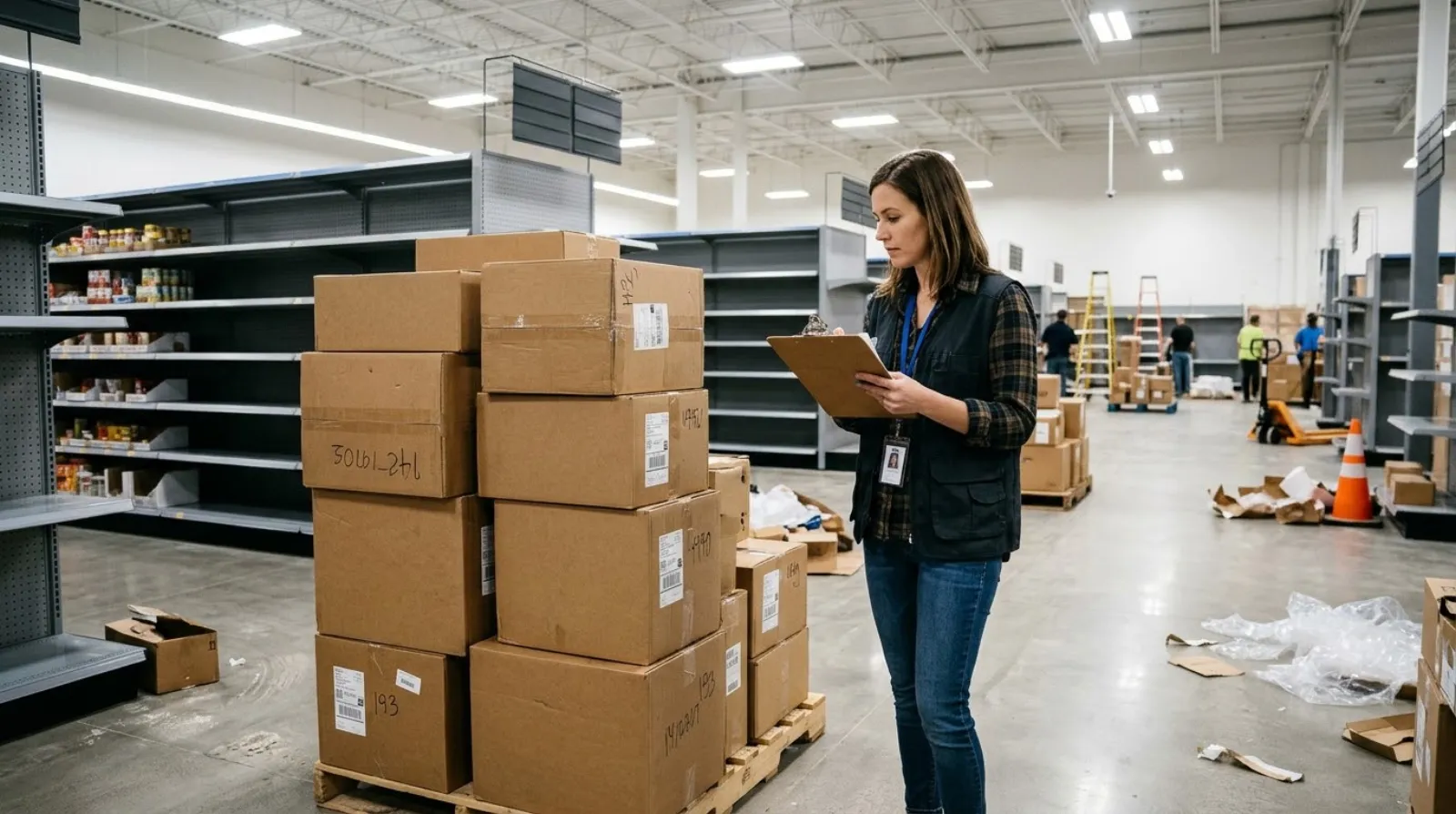
A new-store set checklist succeeds when every product decision, purchase order, and carrier pickup is scheduled backward from the exact day your field crew arrives on site. As outlined in our new-store set operations guide, most set failures are not caused by slow merchandisers—they happen because merchandise, fixtures, or display clips never reached the store dock before the crew walked in.
When teams plan forward from “when we issued the PO,” every vendor operates on its own timetable. Working backward from Set Date (Day 0) forces every supplier and buyer to share one hard ship-by deadline: set date minus 14 calendar days.
A worked example of the set date minus 14 days rule
To see how backward scheduling works on a live store opening, assume Store #142 has a scheduled merchandising set date of November 17 (Day 0). Every milestone locks backward from that morning:
| Milestone | Formula | Worked Date (Store #142) | What Must Be True |
|---|---|---|---|
| Assortment & store lock | Set Date - 45 days | October 3 | Store #142 address, dock hours, planogram SKU list, and assigned vendors finalized |
| PO issued & acknowledged | Set Date - 30 days | October 18 | Every vendor holds a confirmed PO number with matching carton counts and ship-to code |
| Pre-ship vendor check | Set Date - 21 days | October 27 | Reminder sent listing all open POs due to ship within 7 days; backorders flagged |
| Ship-by deadline | Set Date - 14 days | November 3 | Every PO leaves the vendor’s dock with carrier name and valid tracking or PRO number |
| First overdue escalation | Set Date - 12 days | November 5 | Every row still missing tracking gets escalated every 2 business days |
| Pre-arrival dock check | Set Date - 3 days | November 14 | Carrier delivery scan verified at store or local cross-dock; spot-check sheets prepped |
| Merchandising set date | Day 0 | November 17 | Field crew builds displays, stocks shelves, and logs visit report photos |
If a vendor reports on October 27 that a key display rack will not ship until November 12 (only 5 days before November 17), your tracker flags ship date outside window three weeks before the crew travels—giving the buyer time to air-freight the rack or sequence that bay cleanly.
Phase 1: Product and store scope (Set Date minus 45 to 60 days)
Locking product and location details early prevents purchase orders from shipping to the wrong dock or carrying outdated SKU counts. Before any PO is cut, verify these items:
- Confirm the physical ship-to location. New stores under construction frequently route opening orders to a temporary cross-dock, a neighboring hub store, or a regional distribution center rather than the unfinished store street address.
- Separate sellable SKUs from fixtures and POP. Planogram merchandise, heavy display racks, header signage, and clip strips often ship from different facilities under distinct POs. List them as separate tracked rows so a vendor shipping product does not mask missing display brackets.
- Verify pack-out and case-pack minimums. Confirm whether the store needs master cases, inner packs, or pre-built PDQ shippers matching the set planogram.
- Check retailer-specific new-store allowances and manuals. As noted in Tractor Supply’s Vendor Requirements Manual (Rev Q4 2021), chains often apply specific new-store ordering windows and labeling formats that vendors must follow from day one.
Phase 2: Purchase orders and acknowledgments (Set Date minus 30 to 45 days)
A set list without verified PO numbers is just a wish list. Once orders transmit, track confirmation speed and quantity alignment:
- Match every assigned store-vendor pair to a PO. Run an automated or filtered check confirming zero blank PO cells remain across your store matrix by Set Date minus 30 days.
- Enforce 24- to 48-hour PO acknowledgments. Many retail vendor manuals—including Tractor Supply’s guidelines—expect vendors to confirm order receipt within 48 hours and report any price, pack, or stock discrepancy right away.
- Compare PO due dates against the set date. Any PO whose vendor-confirmed delivery date falls on or after Set Date minus 3 days should trigger an immediate due date after set date flag for buyer review.
- Monitor EDI 850 and 855 status where applicable. For EDI-enabled retailers, confirm functional acknowledgments (EDI 997) cleared so an unacknowledged order is not silently sitting unfulfilled.
Teams managing multiple vendors across dozens of stores can structure these checks using dedicated purchase order tracking software for field teams or explore our new-store-set PO tracking pilot overview.
Phase 3: Shipping, labels, and tracking capture (Set Date minus 21 to 14 days)
The 21-to-14-day window before setup is where most delays happen—and where structured follow-up saves the most money.
- Send the 21-day pre-ship summary. Seven days before the ship-by cutoff, send each vendor one consolidated list of their open POs for the upcoming store wave.
- Enforce the Set Date minus 14 days ship-by cutoff. Require both a carrier name and a scannable tracking or PRO number—not just “shipped today”—for every row by Day -14.
- Escalate missing tracking every 2 business days. Follow a consistent reminder cadence, as detailed in how to chase vendors for tracking numbers without chasing, instead of letting stalled POs sit untouched for a week.
- Verify compliance documents and labels. As SPS Commerce highlights, late EDI 856 Advance Ship Notices or missing GS1-128 SSCC-18 pallet labels can trap compliant merchandise at a distribution center dock even when the truck arrives on time. Review our vendor compliance guide for dock-level rules.
Phase 4: Pre-arrival check and set-date execution (Set Date minus 3 days to Day 0)
Three days before your merchandising crew travels, shift focus from vendor docks to store receiving:
- Confirm carrier delivery scans. Check every PRO and parcel tracking link for an actual “Delivered” or “Out for Delivery” scan at the store or designated cross-dock.
- Verify carton counts against the manifest. Ask the store receiving lead or cross-dock coordinator to confirm pallet counts match the packing list and note any visible crushed freight before the team drives in.
- Arm reps with spot-check sheets and report templates. Generate store-specific spot-check sheets listing every expected SKU so reps can quickly flag shorted items on arrival, and standardize closing photos with a store visit report template.
- Document day-zero exceptions cleanly. If a vendor pallet still failed to arrive by Day 0, log a clear photo of the empty bay and the open PO number so the buyer and account manager have immediate proof for recovery or return-visit billing.
How to adjust the ship-by buffer by freight mode and lane
While set date minus 14 calendar days works as the default ship-by anchor for regional parcel and standard LTL shipments, heavy fixtures and long-haul freight lanes need wider margin. Adjusting the cutoff by shipment type prevents distant or appointment-bound loads from arriving after the crew leaves town.
| Freight / Order Type | Recommended Ship-By Anchor | Why the Margin Changes |
|---|---|---|
| Small parcel (UPS / FedEx Ground) | Set Date - 10 to 14 days | Predictable 2- to 5-business-day transit; minimal dock appointment friction |
| Regional LTL (same or adjacent state) | Set Date - 14 days | Covers 3- to 5-day linehaul plus local terminal delivery scheduling |
| Cross-country LTL (>1,200 miles) | Set Date - 18 to 21 days | Absorbs hub transfers, weather delays, and weekend terminal holds |
| Custom fixtures, racking, and POP headers | Set Date - 21 days | Often ships from third-party display houses; missing hardware stalls entire bays |
For regional farm, ranch, and hardware programs where stores sit far outside major metro hubs, confirm rural LTL delivery days per week during Phase 1—covered in our guide to regional farm and hardware new-store programs and our farm and ranch retail coverage service.
Who owns each milestone on a multi-vendor store set
A checklist fails when everyone assumes someone else verified the dock or followed up on a late PO. Assigning explicit ownership across four roles eliminates handoff gaps between buying offices and store aisles:
| Role | Primary Milestones Owned | Verification Artifact |
|---|---|---|
| Retail Buyer / Merchant | Scope lock (Day -45), PO issuance (Day -30), expedite approvals (Day -6) | Approved store-SKU matrix and active PO numbers |
| Vendor CSR & Warehouse | 48-hour PO acknowledgment, GS1-128 labeling, EDI 856 ASN, on-time ship (Day -14) | Carrier name, valid PRO/tracking number, and signed BOL |
| Program Manager / Reset Coordinator | Exception tracking, 48-hour vendor follow-ups, Day -3 delivery verification | Weekly exception report and pre-arrival readiness sheet |
| Field Merchandising Lead | Day -3 dock check, Day 0 bay build, photo documentation of missing stock | Completed store visit report and spot-check log |
Common new-store set mistakes that stall openings
Four preventable errors show up repeatedly when teams move from a two-store test to a 15- or 30-store rollout:
- Shipping to an unstaffed construction address. New retail locations frequently use a temporary cross-dock or neighboring hub store until days before opening; routing freight to the street address too early leads to refused trailers.
- Grouping display hardware under product POs. When a vendor ships sellable SKUs from Warehouse A and steel display brackets from Warehouse B, tracking only the merchandise PO hides missing fixtures until the crew stands in front of an empty gondola.
- Treating “invoiced” as “delivered.” An ERP invoice generated when a label prints does not confirm the carrier picked up the pallet or cleared receiving at the destination dock.
- Overlooking construction-site receiving constraints. Newly built stores often lack dock levelers or full receiving crews before soft opening, requiring liftgate service or advance delivery appointments.
Day-zero exception protocol when freight misses the set date
When a carrier fails to deliver despite pre-set checks, a disciplined Day 0 protocol protects the field team from unbilled return trips and gives the buyer actionable evidence:
- Confirm backroom and cross-dock staging first. Walk the receiving bay with the store manager using the PO number and carrier PRO reference before marking the shipment missing.
- Log the empty bay with clear photos. Document the unfinished planogram section alongside adjacent completed bays using your visit report template.
- Record the exact gap on the spot-check sheet. Note which SKUs or fixture pieces are absent and whether partial cartons arrived damaged or short.
- Escalate same-day with PO and PRO numbers attached. Send the exception summary to the program manager and buyer before noon so recovery freight or a scheduled return visit is approved cleanly.
Running this four-phase checklist consistently turns store openings from last-minute fire drills into predictable, repeatable rollouts.
Frequently asked questions
Why use set date minus 14 days as the vendor ship-by rule?
Fourteen calendar days covers typical regional LTL or ground parcel transit of 3 to 7 business days, plus backroom receiving check-in at a busy construction or grand-opening site, plus a few days of escalation margin if a carrier stalls. Shipping closer than 10 days leaves almost no time to recover a misrouted pallet before the crew arrives.
What happens if a vendor's confirmed due date falls after the set date?
That line should immediately trigger an exception flag in your tracker. Program managers then have three choices: ask the vendor to split-ship available core SKUs via expedited freight, pull stock from a nearby distribution center, or notify the field crew lead early so bays are staged cleanly instead of wasted on site.
Should fixtures and display signage follow the same checklist as sellable merchandise?
Yes, and fixture POs often need an even earlier buffer of set date minus 21 days because custom displays, peg hooks, and header cards frequently ship from separate fulfillment houses. If merchandise arrives on time without the gondola signage or display brackets, field merchandisers still cannot complete the bay.
How early should purchase orders be verified before a new store opens?
Purchase orders should be issued and matched to the store-vendor matrix at least 30 to 45 days before the set date, depending on vendor manufacturing lead times. Confirming PO numbers early ensures vendors acknowledge orders—many retail manuals expect acknowledgment within 24 to 48 hours—before production schedules fill.
What should the field merchandising lead verify 3 days before arriving on site?
Three business days before travel, the field lead should verify carrier delivery scans showing pallets arrived at the store or local cross-dock, confirm backroom staging locations with the store manager, and print or download spot-check sheets listing every expected SKU and bay assignment.
When should a new-store set use a 21-day shipping buffer instead of 14 days?
Use a 21-day ship-by buffer for custom display fixtures, heavy steel racking, cross-country LTL lanes over 1,200 miles, or multi-state seasonal opening waves. That extra week of transit margin protects against liftgate appointment delays and backroom staging bottlenecks at under-construction sites.
What should a field crew do on Day 0 if a vendor pallet is missing?
Do not guess or leave the aisle undocumented. Photograph the empty bay, log the exact missing SKU and PO number in the visit report, check backroom staging and cross-dock transfer logs with store receiving, and trigger an immediate buyer escalation before departing.